

When speaking of pronunciation, it is pretty difficult to make clear distinctions between US and UK accents when there is a wide variety of accents within both, the US and UK. For instance: a Texan and a New Yorker are both Americans, but have very different accents. The same goes for British accents in London, Manchester and Glasgow.
American English is Actually Older
When the first settlers set sail from England to America, they took with them the common tongue at the time, which was based on the rhotic speech (pronunciation with the r sound in a word).
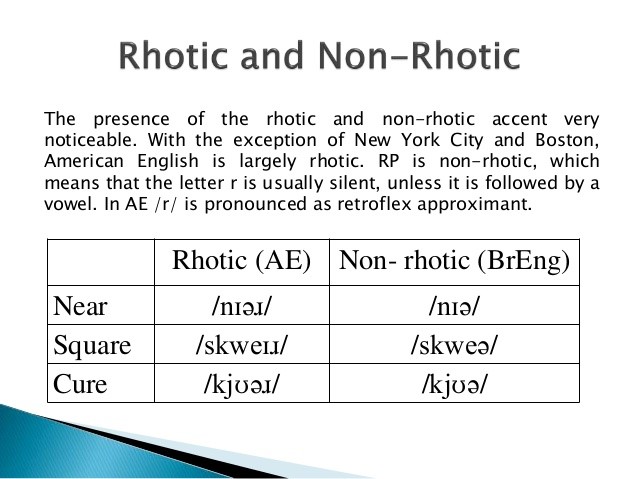
In wealthy southern cities of the UK, people from the new higher classes wanted a way to distinguish themselves from everyone else, so they started changing their rhotic speech to a soft r sound, saying words like winter as “win-tuh” instead of “win-terr”.
SPELLING
American spelling was invented as a form of protest.
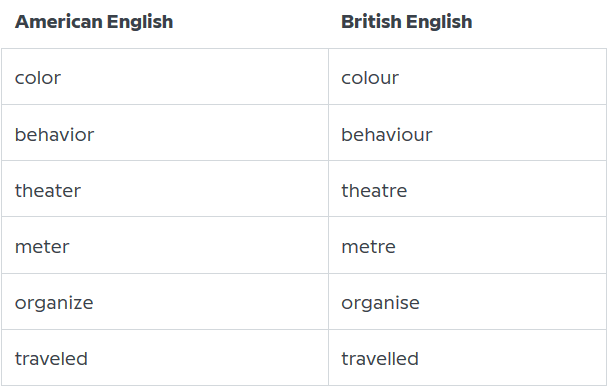
Noah Webster, (English-language spelling reformer), wanted American spelling to be different from UK spelling. As a way of America showing its independence from the former British rule: He dropped the letter u from words like colour and honour – which had developed from the French influence in England – to make them color and honor instead. He did the same to words ending in –iseto make them –ize.
VOCABULARY
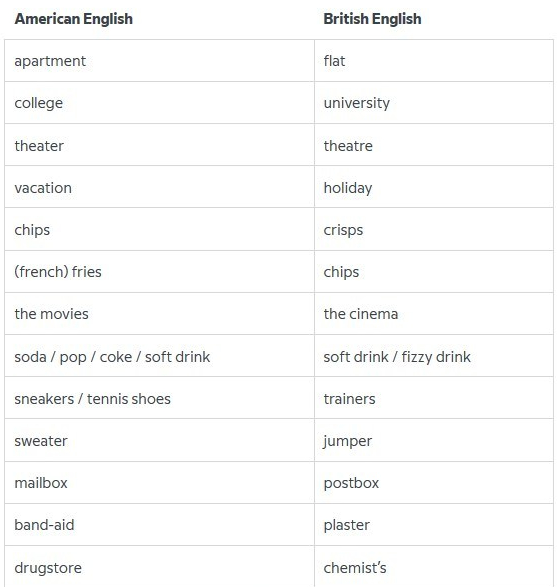
The Americans and the British have some words that differ from each other.
The following is a list of words that have different names, depending on what form of English is being used.
GRAMMAR DIFFERENCES

- In American English, collective nouns are considered singular (e.g. The band is playing). In contrast, collective nouns can be either singular or plural in British English, although the plural form is most often used (e.g. The band are playing).
- The British are more likely to use formal speech, such as ‘shall’, whereas Americans favour the more informal ‘will’ or ‘should’.
- Americans continue to use ‘gotten’ as the past participle of‘get’, which the British have long since dropped in favour of ‘got’.
- ‘Needn’t’, which is commonly used in British English, is rarely, if at all used in American English. In its place is ‘don’t need to’.
- In British English, ‘at’ is the preposition in relation to time and place. However, in American English, ‘on’ is used instead of the former and ‘in’ for the latter.
Check out what other words differ from British to American English
 ENGLAND
Once more you guys leave me breathless. I am staggered at how much I did not know about England. I’ve had an extremely positive experience going through it. My favorite part is the part of the accents. British people have the funniest accent
Me gustaLe gusta a 1 persona
Do you think they have the funniest accent!? Listen to a guy from Australia and let me know if you change your mind. https://www.youtube.com/watch?v=ZnioDeQNlxQ
Me gustaMe gusta
It would have never crossed my mind that American spelling arose as a way of protesting and showing American independence from the British. So… thank you, guys for enlightening me. Bearing in mind these certain things helps us to get to know better the language we are learning day by day.
Me gustaMe gusta
I still confuse some words and their different spellings in American and British English, but this blog is very helpful to learn a little bit about the differences. and it is interesting and something new for me, I’ve never imagined the American spelling was invented as a way of protesting, I did not know that.
I really like your blog.
Me gustaLe gusta a 1 persona